
Are the Northern Lights Visible Tonight?
Checking the Sky…
Fetching live space-weather data from NOAA.
Live Aurora Conditions Right Now
The four numbers that decide tonight's show — live from NOAA
KP Index History & Geomagnetic Storm Tracking
Kp Index Trend
No data
Where Can You See the Northern Lights Tonight?
Real-Time Aurora Visibility Map
NOAA OVATION Model
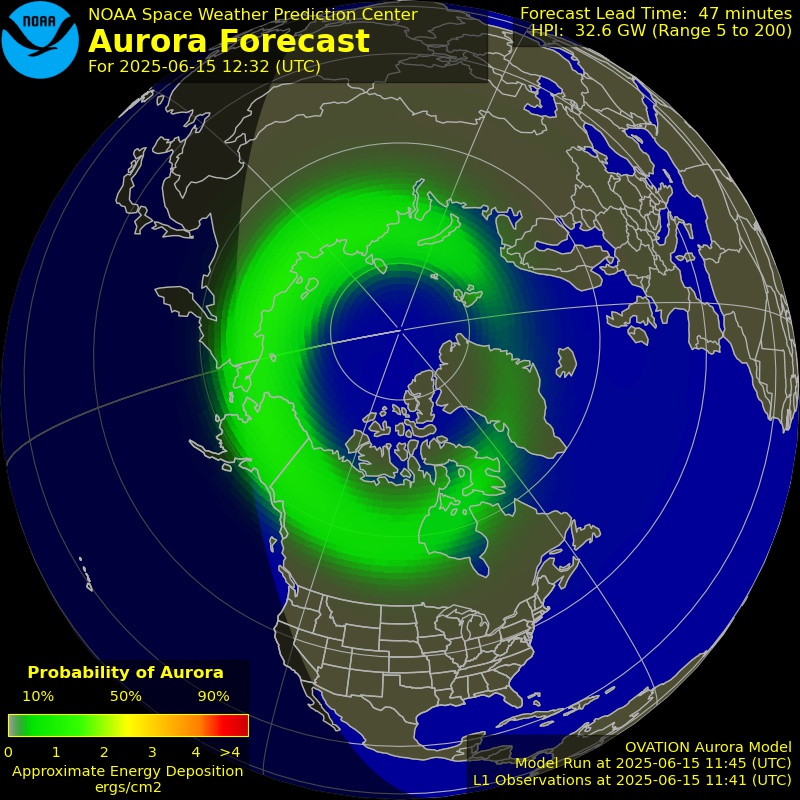
The green oval is where the aurora is now. During moderate activity (KP 3–4) it covers Canada, Alaska, Iceland, northern Scotland, and Scandinavia.
During geomagnetic storms (KP 5–7) the oval pushes into the northern United States — Minnesota, Wisconsin, Michigan, Maine. KP 8+ storms have reached as far south as Georgia, Alabama, Arizona, and northern California. If the oval is over you and your sky is dark, go outside.
How to See the Northern Lights
The questions every aurora hunter asks, answered in plain language.
What KP Index Do You Need to See the Northern Lights?
It depends on your latitude. KP 3–4 lights up Alaska, Canada, Iceland, and Scandinavia. KP 5+ (a G1 storm) brings the aurora to northern US states like Minnesota, Michigan, and Maine. KP 8–9 storms have reached as far south as Georgia and northern California.
What Time of Night Is Best?
Around local midnight — typically 10pm to 2am. Displays arrive in bursts (substorms) lasting 10–30 minutes, so keep checking through the night rather than giving up after one look.
What Is the KP Index?
A 0–9 scale of global geomagnetic activity, updated every three hours. Higher KP pushes the aurora further from the poles; KP 5 and above is classified as a geomagnetic storm (G1–G5).
Why Does the Bz Field Matter?
Bz is the north–south direction of the solar wind's magnetic field. When it points south (below about -3 nT), it connects with Earth's field and lets solar wind energy pour in — the on-switch for bright aurora.
Where Should You Look?
Away from city light pollution, with an open view of the northern horizon. Give your eyes 15–20 minutes to adapt to the dark — the darker your sky, the lower the KP you can see.
Can a Phone Camera See It Better Than Your Eyes?
Yes. A 3–10 second exposure or night mode picks up color and structure your eyes miss, especially in weaker activity. Suspect a faint glow? Point your camera north and check.